Legal ADDA

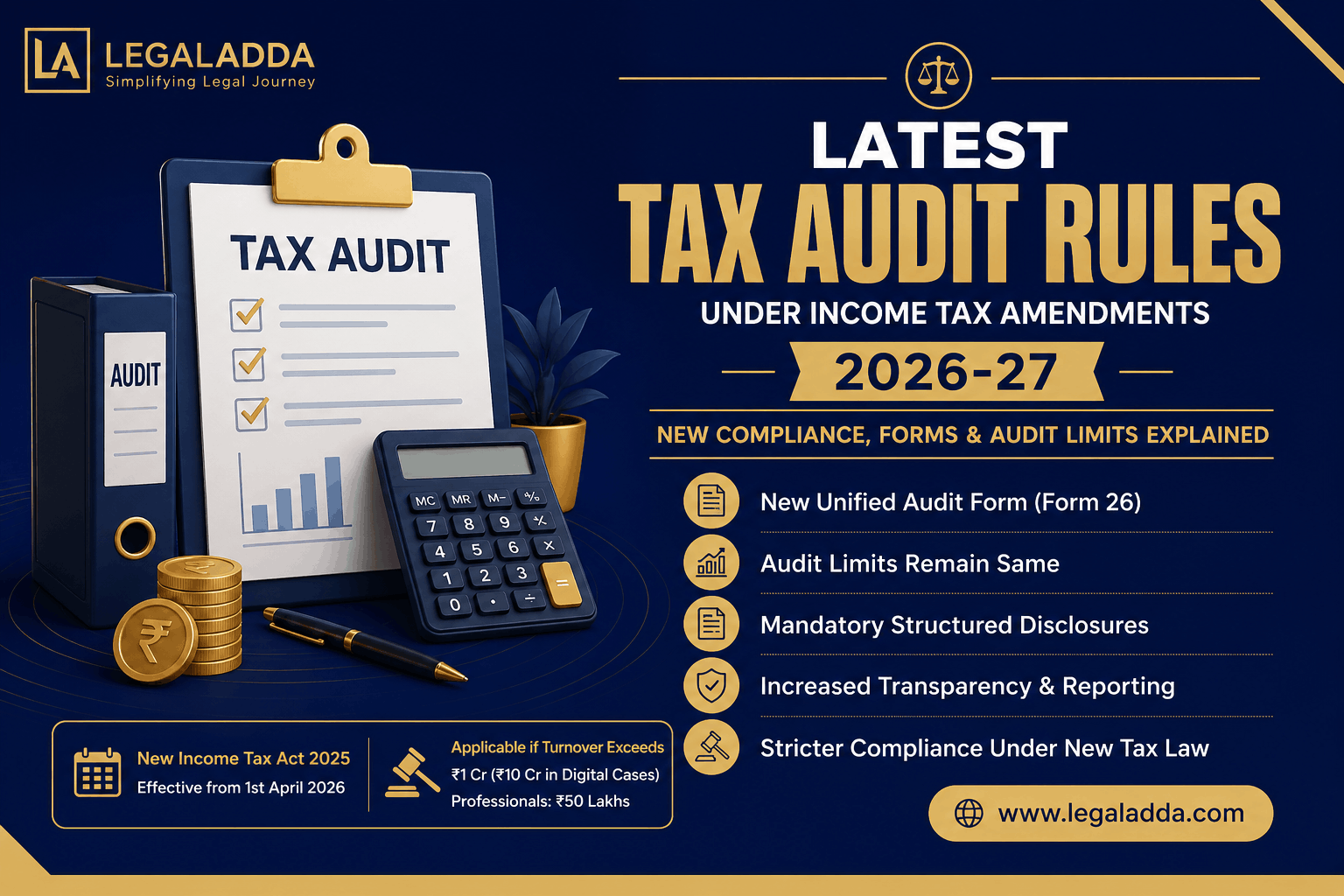
Latest F&O Audit Rules Under Income Tax Amendments 2026–27

The Latest F&O Audit Rules under Income Tax Amendments 2026–27 bring important updates for traders dealing in futures and options, especially in relation to tax audit applicability, turnover limits, and compliance requirements. Under the Income Tax Act, F&O trading is treated as a non-speculative business, which means profits and losses are considered business income and may attract tax audit under Section 44AB. The amended rules focus on higher audit thresholds, increased emphasis on digital transactions, and clearer guidelines on presumptive taxation under Section 44AD. These changes are aimed at simplifying compliance while ensuring accurate reporting of trading income. For F&O traders, understanding these updated provisions is crucial to avoid penalties, ensure correct turnover calculation, and stay compliant with the latest tax regulations for FY 2026–27.

Overview of Latest Amendments (2026–27 Update)

The Income Tax Amendments for FY 2026–27 have introduced significant changes impacting F&O traders, particularly in the area of tax audit applicability and compliance. The government has continued to promote digital transactions by allowing a higher tax audit threshold of ₹10 crore where cash transactions are minimal, while the standard ₹1 crore limit still applies in other cases.

Further, the provisions of Section 44AD (Presumptive Taxation) remain crucial, where traders declaring lower profits than the prescribed 6%/8% may be required to undergo a tax audit. The amendments also emphasize accurate turnover calculation as per ICAI guidance, ensuring better transparency in reporting F&O income.

Overall, these updates aim to simplify tax compliance, reduce unnecessary audits for genuine taxpayers, and bring more clarity to F&O taxation rules, making it easier for traders to comply with the law while avoiding penalties.

Why Tax Audit is Important for F&O Traders

  • Ensures Legal Compliance: Helps traders comply with Income Tax provisions under Section 44AB.
  • Accurate Income Reporting: Verifies correct reporting of F&O profits and losses.
  • Avoids Penalties: Prevents penalties under Section 271B for non-compliance.
  • Supports Loss Claims: Proper audit helps in claiming and carrying forward losses.
  • Reduces Tax Notices: Minimizes chances of scrutiny or notices from the Income Tax Department.
  • Maintains Proper Records: Ensures books of accounts and trading records are properly maintained.
  • Builds Financial Transparency: Presents a true and fair view of trading activities.
  • Helps in Tax Planning: Assists in better financial and tax planning decisions.

How F&O is Treated as Non-Speculative Business

Under the Income Tax Act, futures and options (F&O) trading is classified as a non-speculative business because these transactions are carried out on recognized stock exchanges and are settled without actual delivery, as per prescribed regulations. Unlike speculative trades (such as intraday equity trading), F&O transactions are specifically excluded from the definition of speculative transactions under Section 43(5).

This classification has important tax implications. Profits and losses from F&O trading are treated as business income, allowing traders to claim business expenses, set off losses against other income (except salary), and carry forward losses for future years as per tax rules. Additionally, since it is considered a business activity, F&O trading may attract tax audit requirements under Section 44AB, depending on turnover and income conditions.

Overall, treating F&O as a non-speculative business provides more flexibility in taxation but also brings additional compliance responsibilities for traders.

Difference Between Speculative vs Non-Speculative Income

Understanding the difference is crucial for F&O traders because it directly impacts tax treatment, loss adjustment, and audit applicability.

🔹 Speculative Income
  • Arises from transactions where actual delivery is not intended
  • Example: Intraday equity trading
  • Governed under Section 43(5)
  • Loss Set-off: Can be set off only against speculative income
  • Carry Forward: Allowed for 4 years only
  • Tax Treatment: Considered high-risk and restricted for adjustments
 
🔹 Non-Speculative Income
  • Arises from business activities including F&O trading
  • F&O is treated as non-speculative when traded on recognized stock exchanges
  • Loss Set-off: Can be set off against any income except salary
  • Carry Forward: Allowed for 8 years
  • Tax Treatment: Treated as normal business income with broader benefits
 

🔹 Key Differences at a Glance

BasisSpeculative IncomeNon-Speculative Income (F&O)
NatureHigh-risk, no deliveryBusiness income
ExampleIntraday tradingFutures & Options trading
Loss Set-offOnly against speculativeAgainst any (except salary)
Carry Forward4 years8 years
Tax FlexibilityLimitedMore flexible

F&O Tax Audit Limit 2026–27: New Turnover Rules Explained

CriteriaAudit LimitConditionAudit Applicability
Basic Limit₹1 CroreApplicable to all tradersAudit required if turnover exceeds ₹1 Cr
Higher Limit₹10 CroreCash transactions ≤ 5%Audit required if turnover exceeds ₹10 Cr
Presumptive TaxationUp to ₹2 CroreProfit declared less than 6%/8%Audit mandatory
Loss CaseAny TurnoverIncome exceeds basic exemption limitAudit may be required
ParticularsDetails
Basic Audit Limit₹1 Crore
Enhanced Audit Limit₹10 Crore (if cash transactions ≤ 5%)
Applicable SectionSection 44AB of Income Tax Act
Type of IncomeNon-Speculative Business (F&O Trading)
Turnover Calculation MethodAbsolute Profit & Loss Method (as per ICAI guidance)
Includes in TurnoverTotal of profits + losses (absolute value)
Presumptive Taxation SectionSection 44AD
Minimum Profit Requirement6% (digital transactions) / 8% (cash transactions)
Audit Trigger ConditionProfit declared below 6%/8% under 44AD
Cash Transaction ConditionMust not exceed 5% to avail ₹10 Crore limit
Loss Case AuditAudit may be required if income exceeds exemption limit & loss declared
Compliance RequirementMaintain books + file audit report (Form 3CA/3CB & 3CD)
Penalty for Non-Audit0.5% of turnover or ₹1,50,000 (whichever is lower)
 
Key Changes in F&O Tax Audit Rules Under Latest Amendments (2026–27)

🔹 Increased Thresholds

  • Basic tax audit limit remains ₹1 crore
  • Limit extended up to ₹10 crore for digital transactions
  • Applicable only if cash transactions ≤ 5% of total receipts & payments
  • Reduces audit burden for high-volume digital traders
 

🔹 Digital Transaction Consideration

  • Strong focus on cashless / digital trading
  • Higher audit limit available for online trading transactions
  • Encourages use of banking channels & proper records
  • Helps in better transparency and tracking of income
 

🔹 Compliance Updates

  • Mandatory to maintain proper books of accounts
  • Turnover must be calculated as per ICAI guidelines (P&L method)
  • Timely filing of tax audit report (Form 3CA/3CB & 3CD)
  • Increased scrutiny on incorrect reporting or under-reporting
  • Penalty applicable under Section 271B for non-compliance
F&O Tax Audit Filing Requirements, Due Dates & Penalties

🔹 Forms Required for F&O Audit

  • Form 3CA / 3CB – Audit report (3CA if accounts already audited, 3CB if not)
  • Form 3CD – Detailed statement of financial and tax particulars
 

🔹 Due Dates for Tax Audit Filing

  • Standard due date: 30th September (may be extended by government)
  • Applicable for FY 2025–26 (AY 2026–27)
  • Late filing may lead to penalties and compliance issues
 

🔹 Penalty for Non-Compliance

  • Applicable under Section 271B
  • Penalty = 0.5% of turnover
  • Maximum penalty capped at ₹1,50,000
Common Mistakes in F&O Tax Audit

F&O traders often make critical mistakes that can lead to penalties and tax notices. One of the most common errors is incorrect turnover calculation, as many traders fail to follow the proper absolute profit and loss method prescribed by ICAI. Another major issue is ignoring presumptive taxation rules under Section 44AD, especially when declaring lower profits without considering audit applicability. Additionally, late filing of audit reports can result in penalties and compliance issues. Traders also frequently commit misclassification of income, such as treating F&O income as speculative instead of non-speculative business income. Avoiding these mistakes is essential to ensure accurate reporting, smooth compliance, and prevention of unnecessary legal complications.