ITR Amendments 2026: Latest Updates and New Rules Explained
Welcome to our blog! Today we talk about ITR Amendments 2026. The year 2026 brings several important changes in Income Tax Return (ITR) filing with the introduction of the Income Tax Act, 2025, along with updates in ITR forms, disclosures, and compliance requirements. These amendments focus on simplifying the filing process, improving transparency, and strengthening reporting systems for taxpayers. Key changes include revised reporting formats, stricter disclosure norms, and better integration with digital systems to ensure accuracy and reduce errors. Whether you are a salaried individual, freelancer, or business owner, understanding these latest updates for Assessment Year 2026-27 will help you file your ITR correctly, avoid penalties, and stay fully compliant with the new income tax rules.
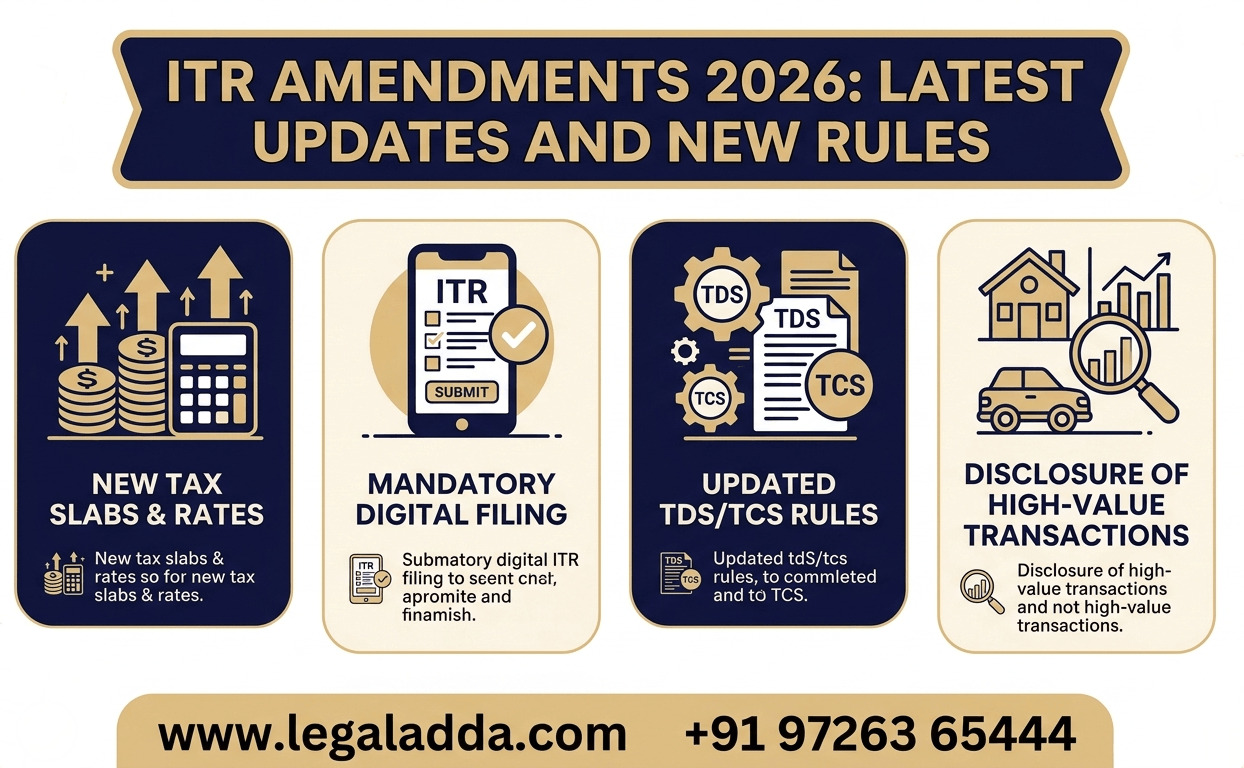
Overview of Income Tax Act 2025 and ITR Amendments 2026
New Income Tax Act, 2025
The Government of India has introduced the Income Tax Act, 2025 effective from 1 April 2026, replacing the existing Income Tax Act, 1961. The new Act brings a revised structure with updated provisions and a stronger focus on digital compliance and streamlined reporting. It introduces organized sections, improved alignment with automated systems, and enhanced integration with pre-filled data to support accurate tax filing and reduce inconsistencies in reporting.
ITR Filing Applicability for AY 2026-27
It is important to note that ITR filing for AY 2026-27 will continue to be governed by the Income Tax Act, 1961, as it relates to income earned during FY 2025-26. The provisions of the new Act will apply from FY 2026-27 onwards (AY 2027-28). However, recent updates have already been incorporated into the ITR filing process, including enhanced disclosure requirements, improved data validation through AIS/TIS, and more detailed pre-filled information. These changes aim to strengthen compliance, ensure accurate reporting, and reduce the chances of errors or tax notices.
Renaming and Restructuring of Income Tax Forms 2026
Proposed Changes
One of the key proposed changes under the Income Tax Act, 2025 is the renaming and restructuring of income tax forms through a new numbering system. This initiative aims to improve consistency, standardization, and alignment with the new tax framework. However, these changes are part of the new system and are not applicable for AY 2026-27.
Changes in Form Naming
- Form 16 may be renamed as Form 130
- Form 26AS may be renamed as Form 168
- Form 16A may be renamed as Form 131
👉 These changes are currently proposed and expected to be implemented in future years.
Merger of Form 15G and 15H
- Form 15G and Form 15H may be merged into a single Form 121
- This aims to simplify the TDS declaration process, especially for individuals and senior citizens
🔹 Current Status (Important for Taxpayers)
- For AY 2026-27, existing form names will continue to be used
- There is no change in the current ITR filing process due to form renaming
- The new numbering system is expected to be लागू from upcoming financial years
Disclosure and Reporting Requirements in ITR 2026
The CBDT has introduced important updates in ITR forms for AY 2026-27 to improve accuracy, transparency, and compliance.
🔹 Revised Structure of ITR Forms
- More structured and organized format
- Easier identification based on income type
🔹 Changes in Eligibility
- Restrictions on ITR-1 and ITR-4 in certain cases
- Foreign income holders must use ITR-2 or ITR-3
🔹 Enhanced Disclosure
- Capital gains reporting
- Foreign assets & income
- Political donations
- Business transactions including F&O
🔹 High-Value Transactions
- Property transactions
- Large deposits/withdrawals
- Significant investments
🔹 Improved Pre-Filled Data
- Data from AIS & TIS integrated
- Reduced manual entry errors
🔹 Stronger Data Matching
- Automated system verification
- Mismatches may trigger notices
🔹 Additional Fields Added
- Secondary contact details
- Digital transaction reporting
🔹 Filing Due Dates
- ITR-1 / ITR-2: 31 July 2026
- ITR-3 / ITR-4: 31 August 2026
New Disclosure and Reporting Requirements in ITR 2026 (Latest Update)
- Taxpayers must ensure all income details match with AIS and TIS
- Mismatch in income, TDS, or transactions may lead to notices
- Pre-filled ITR data is now more detailed and must be verified carefully
- Mandatory reporting of all income sources, including:
- Interest income
- Dividend income
- Capital gains
- No omission is allowed as data is already tracked by the department
- TDS details must match with Form 26AS and AIS
- Incorrect claims of tax credit can lead to processing delays or notices
- Proper disclosure of capital gains from shares, mutual funds, and property
- Sale and purchase details must align with reported transaction data
- Mandatory reporting under Schedule FA for foreign assets
- Foreign income must also be disclosed correctly
- ITR forms now come with enhanced pre-filled data
- Includes income, TDS, and financial transactions
- Taxpayers must review and correct before submission
- Increase transparency in tax filing
- Reduce chances of incorrect reporting
- Enable automated verification and faster processing
Updated Tax Slabs and New Tax Regime Benefits (2026)
The new tax regime continues to remain the default tax system for individuals in 2026, providing a more streamlined and straightforward way of calculating income tax. While the tax slab rates have largely remained unchanged, the government has made this regime more practical by offering key benefits like rebate and standard deduction. Under the current rules, individuals with total income up to ₹7 lakh can claim a full rebate under Section 87A, resulting in zero tax liability. In addition, salaried individuals and pensioners can claim a standard deduction of ₹50,000, which further reduces taxable income. This makes the new regime a suitable option for taxpayers who prefer a simple structure without managing multiple deductions and exemptions.
💡 ₹50,000 Standard Deduction available
Benefits of New Tax Regime
The new tax regime offers reduced tax rates, helping taxpayers save more when they are not claiming multiple deductions.
With fewer deductions and a clear slab structure, tax calculation becomes straightforward and user-friendly.
This regime is automatically selected while filing ITR, reducing confusion. Taxpayers can still opt for the old regime if it is more beneficial.
No need to maintain multiple proofs for deductions like 80C, 80D, etc., which reduces compliance burden.
Due to simplified structure and fewer details, return filing becomes quicker and processing time is reduced.
Since most deductions are removed, the tax calculation is clear and easy to verify.
Ideal for individuals with fixed income and limited deductions, offering a clean tax structure.
Taxpayers have the option to switch between old and new regimes (as per rules), allowing better tax planning.
With fewer fields and calculations, the chances of mistakes while filing ITR are lower.
Taxpayers are not required to invest in specific schemes just to save tax, giving more financial flexibility.
The new regime aligns well with pre-filled ITR forms and automated systems, ensuring smoother filing experience.
Income Tax ITR Filing Due Dates & Compliance Updates for AY 2026-27
The Income Tax Department has prescribed the ITR filing due dates for Assessment Year 2026-27 under the existing provisions of the Income Tax Act, 1961. Salaried individuals and taxpayers who are not required to undergo audit must file their Income Tax Return by 31 July 2026, while cases where a tax audit is applicable are required to file by 31 October 2026. In certain business or professional cases, extended timelines may apply depending on specific compliance requirements and reporting obligations.
It is important to note that although the Income Tax Act, 2025 has been introduced and will come into effect from 1 April 2026, the ITR filing for AY 2026-27 will still be governed by the existing law. The new tax framework will mainly apply to income earned in Financial Year 2026-27 and onwards. Additionally, taxpayers are allowed to revise their returns within the prescribed time limit to correct any errors or omissions, which helps in maintaining accurate reporting and ensures better compliance with tax regulations.
Latest Disclosure Requirements in ITR Forms 2026
In 2026, ITR forms now require more detailed disclosures to improve transparency and reduce income mismatches. Taxpayers must provide accurate and structured financial information while filing returns.
AIS / TIS Improvements in 2026
In 2026, the AIS (Annual Information Statement) and TIS (Taxpayer Information Summary) systems have been improved to make Income Tax Return (ITR) filing more accurate, simple, and error-free. These updates ensure better financial data reporting and reduced mismatches.
ITR-U (Updated Return Facility) 2026
In 2026, the ITR-U (Updated Return Facility) allows taxpayers to revise previously filed returns, correct mistakes, and report missed income within a defined time frame, ensuring accurate and transparent tax compliance.
Filing Time Limit
ITR-U can be filed within 48 months from the end of the relevant assessment year.
Purpose of ITR-U
It helps taxpayers correct errors or omissions in previously filed Income Tax Returns without any notice requirement.
Income Reporting Scope
Additional or missed income such as salary, business income, capital gains, or other taxable income can be reported.
Voluntary Compliance
ITR-U promotes voluntary correction of tax returns and improves compliance before any scrutiny or action.
Additional Tax Rule
Extra tax is applicable based on how late the updated return is filed, increasing with delay.
Penalty Protection
Reduces chances of penalties, scrutiny, and income tax notices by proactively updating returns.
Applicable Income Types
Applicable to salary, business income, capital gains, and other taxable income categories.
Final Outcome
Ensures accurate tax records, improved compliance, and a clean financial reporting history.
